
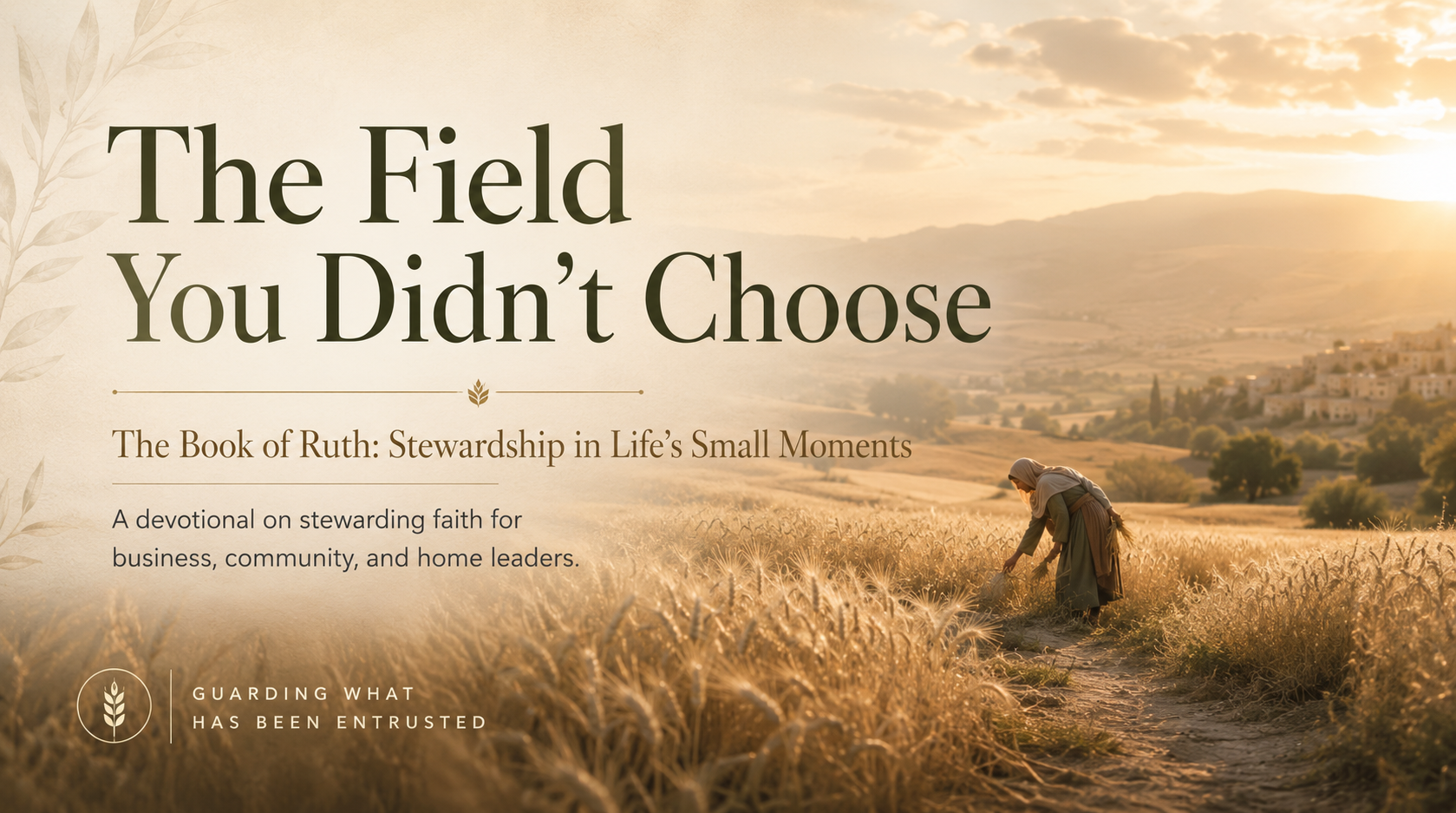
The Book of Ruth: Stewardship in Life’s Small Moments
The book of Ruth reveals how God advances His greatest plans through ordinary days. A devotional on stewarding faith for business, community, and home leaders.
Guarding What Has Been Entrusted
We are trained to look for God in the parted sea. We expect Him in the launch, the breakthrough, the healing, the moment the crowd falls silent because something undeniable just happened. So we spend our lives standing at the edge of the water, waiting for the drama, and we miss Him entirely, because most of the time He is not at the sea. He is in the field.
The book of Ruth opens in the days when the judges ruled (Ruth 1:1, ESV). That is not a neutral timestamp. It is the darkest chapter of the nation’s story, the era whose verdict was everyone did what was right in his own eyes (Judges 21:25, ESV). While the national headline reads spiral and apostasy, God is quietly running a second story underneath it: a widow, a field, and a bag of barley. The loud era and the hidden work are happening at the same time.
Watch how rarely God moves on-screen in this book. The narrator credits Him directly only twice, once at the beginning and once at the end. He had visited his people and given them food (Ruth 1:6, ESV), and later He gave her conception (Ruth 4:13, ESV). Everything in between is ordinary human decision, farm law, and a legal transaction at a town gate. No fire falls. No angel appears. The mechanism of providence in Ruth is not miracle. It is the mundane, faithfully stewarded.
The hinge of the whole book is a single sentence: she happened to come to the part of the field belonging to Boaz (Ruth 2:3, ESV). The Hebrew is almost playful, “her chance chanced upon,” a deliberate wink from the narrator. What felt like luck to a grieving foreign woman was, to the reader who knows the ending, the turning point of salvation history. Ruth teaches you to reread your coincidences as governance.
Because here is where the small story detonates. It ends in a genealogy: Obed, then Jesse, then David (Ruth 4:17-22), and Matthew 1:5 seats this Moabite widow inside the bloodline of Jesus. The most forgettable event imaginable, a woman deciding which field to glean, turned out to be load-bearing for the Messiah. God was never doing something small. He was doing the largest thing possible in the smallest, most overlooked moments of an ordinary harvest.
That is the truth we now have to let convict us in three places we actually lead.
For the Business Leader: The Margin You Refuse to Squeeze
You believe your legacy will be built in the room where the big decision gets made. The raise. The launch. The number. Ruth quietly disagrees.
The instrument God used to rescue Ruth and Naomi was not a miracle. It was an accounting decision. Boaz farmed under the gleaning laws: leave the corners, do not strip the field bare, leave the edges for the sojourner, the fatherless, and the widow (Leviticus 19:9-10; Deuteronomy 24:19-21). Every landowner in Israel faced the same daily choice you face every quarter: maximize the yield to the last grain, or leave margin on the table by conviction. Boaz left the margin. And the margin he refused to squeeze became the exact channel through which redemption walked into his field.
Here is the paradigm shift. He never knew what he was doing while he did it. He was not being generous as a strategy. He was simply a man who honored an ordinance when no one was auditing him, and in honoring it he stewarded the line of the coming King. God does His largest work in your business through the small integrity you keep when there is no spotlight and no upside you can see.
You will not steward your faith at the podium. You will steward it in the ledger nobody checks, in the corner of the field you leave un-harvested because a person matters more than a percentage point. It is required of stewards only that they be found faithful (1 Corinthians 4:2, ESV). Not brilliant. Not celebrated. Found faithful, in the very thing you were tempted to call too small to matter.
The open hand that refuses to maximize is not a leak in your operation. It is the door providence uses.
For the Community Leader: The One Who Stayed
In an era when everyone was doing what was right in his own eyes, what held the future together was not a program or a platform. It was one woman refusing to leave another.
Ruth and Naomi are exactly the people a community leader is trained to overlook: no title, no influence, no headline. Yet the word the book keeps using for what passes between them is hesed, covenant loyalty, the same word Scripture uses of God Himself. Ruth shows hesed to Naomi. Boaz shows it to Ruth (Ruth 2:20; 3:10). And God’s hesed underwrites all of it. The infrastructure of a rescued community was not built at scale. It was built one unwitnessed act of loyalty at a time.
Then watch what kind of leader Boaz becomes. He steps up as the go’el, the kinsman-redeemer (Leviticus 25:25; Deuteronomy 25:5-10), and notice the stewardship logic buried in that role. The redeemer does not seize the asset. He buys back what was lost and restores it to its rightful line, raising up a name for the one who had none. The estate is never his to own. He pays to give it away.
That is the counter-intuitive heart of community leadership. The strong person in the story does not accumulate. He redeems. You are not called to build a community around your name; you are called to restore names to the people who lost theirs.
Whoever is faithful in a very little is also faithful in much (Luke 16:10, ESV). The community you actually change is not the crowd you gather. It is the one person you refuse to walk away from, the one estate you buy back and hand to its rightful owner, the small covenant loyalty you keep long after it stops being visible or convenient.
For the Home Leader: The Faith You Guard Across the Threshold
Ruth is the purest picture in Scripture of stewarding a faith you did not inherit.
She is a Moabite, born into a people fenced out of the assembly (Deuteronomy 23:3). Faith was not her bloodline. And yet she stands on a road with a bitter, empty mother-in-law and says your God shall be my God (Ruth 1:16, ESV). Then she does the harder thing: she guards that borrowed faith with a loyalty so costly the narrator can only describe it with God’s own covenant word. Faith in this house is not a heritage handed down automatically. It is a trust chosen, then kept.
This is where the home leader has to sit down. The most consequential decisions in Ruth are domestic ones, made in grief, in obscurity, with no audience. A widow deciding whether to stay. A widow deciding which field to walk into that morning. Ordinary, unremarkable, the kind of choice you would never think to write down. And that choice carried the Messiah.
You are stewarding a line you cannot see. Obed, Jesse, David. The barley Ruth gathered in a field she stumbled into fed the great-grandmother of a king and, through him, the King of kings. The smallest faithfulness inside your home, the loyalty no one is watching, is load-bearing for generations you will never meet.
Who has despised the day of small things? (Zechariah 4:10, ESV). We do, every time we assume the mundane rhythms of a household are too ordinary to be holy. But the Word Himself spent thirty hidden years in a town that earned the sneer can anything good come out of Nazareth? (John 1:46, ESV) before three public ones. God’s default setting is the hidden home. Steward the faith across your threshold as if a kingdom depended on it, because a kingdom did.
The Final Charge
Stop waiting at the edge of the sea.
The stewardship of faith is not proven in the sea-parting moments, because those are rare and God supplies the drama Himself. It is proven in the field. In the margin you leave. In the person you refuse to abandon. In the borrowed faith you guard when the house is dark and no one is applauding. Ruth did not know she was carrying the line of the King. She only knew which field to walk into that day, and she was faithful in it.
Spiritual growth is not the pursuit of a bigger assignment. It is faithfulness in the small one, kept long enough that you look up one day and discover you were carrying something eternal the whole time. Go and be faithful in the field you did not choose. God is already working there, in the smallest detail, to fulfill a plan larger than you can see.
A Prayer
Heavenly Father, I have been standing at the sea, waiting for the dramatic thing, and I have walked past the field where You were already working. Forgive me for calling ordinary what You call holy. Teach me to keep the small integrity when no one is watching, to stay loyal to the one person in front of me, and to guard the faith I carry as if a kingdom depended on it. I cannot see the line I am stewarding. I trust that You can. Make me faithful in the little, and let that be enough for You to do something I will not live to see. In the name of Jesus, Amen.
For Your Reflection
Where in your leadership are you squeezing the margin God is asking you to leave? Name the one field, the one person, or the one quiet loyalty He is calling you to steward this week, long before you can see what it is for.

The Line She Couldn’t See
Halbrook had a bad decade. When the fittings plant locked its gates, it took the payroll, the diner traffic, and most of the town’s patience with it. People stopped waving from their porches. Everyone started doing the math on everyone else. It became the kind of place where a man would step over a stranger to save himself a dollar and call it being careful.
Marisol worked the overnight shift at the Route 9 diner, the last light burning on that stretch of road after midnight. She was not anyone the town would have named if you asked them who mattered. She refilled coffee, she wiped counters, she went to a small church on Sundays where the pews had more empty space than people, and she went home to an apartment that was quiet in the way that grief is quiet. Nobody was watching her life. She had made a kind of peace with that.
She did have one habit her manager hated.
At the end of every night there was food that was going into the trash regardless, the last of the eggs, a heel of bread, coffee turning bitter in the pot. Company policy said toss it. Marisol kept a quieter policy. If someone wandered in cold and empty at that hour, she set a plate in front of them and rang up nothing. “You are giving away the margin,” her manager told her, more than once, tapping the register like it was Scripture. She never argued with him. She just kept leaving one corner of the night unswept, in case somebody needed it.
Most nights, nobody came. She wiped the counter down anyway.
Then, on a February night when the wind came straight off the fields and found every gap in the door, a boy got off the last bus at the wrong stop. He was sixteen, maybe seventeen, in a coat built for a warmer state, and he had not meant to land in Halbrook at all. He had meant to keep going. But the bus pulled away before he understood his mistake, and there was nothing on that road but dark storefronts and one lit window, so he walked toward the light because it was the only light there was.
He had no money. Marisol saw that before he said a word. She had seen it a hundred times, the way a person stands in a doorway when they have nothing in their pockets and less than nothing in their chest.
She did not ask him what he was running from. She did not tell him about God. She set down eggs and toast and coffee, and she refilled the cup twice, and she let him sit in the warm until his hands stopped shaking. When he fell asleep in the corner booth she left him there. In the morning she gave him the phone number of a shelter two towns over, and two twenty-dollar bills folded small so he would not feel the size of them, and she watched him go.
She never saw him again. Over the years she forgot him, mostly, the way you forget one plate among ten thousand plates. She never knew his name. He never knew hers. She kept working the overnight shift until her knees gave out, and then she worked the morning one, and the town stayed small and the church stayed thin, and as far as Marisol could tell she had lived a life that would leave no mark on anything.
She was wrong about that. She had simply been faithful in a field she could not see the edges of.
The boy got to the shelter. Someone there did for him what she had done, and then someone after that, and slowly the running in him wore itself out. He grew into a man who could not walk past a cold doorway without stopping, because a woman he could not name had once refused to walk past his. He spent thirty years keeping lights on for people the math had written off. He never ran anything large. He just kept setting plates in front of strangers and ringing up nothing, and telling anyone who would listen about a diner on Route 9 where a tired woman fed him and asked him for nothing back.
Marisol was old and mostly blind when a young woman found the right town, and then the right apartment, and sat down across from her and took her hand. She said she was the daughter of a man Marisol had helped a long time ago at a diner. She said her father had told the story every year of his life, and that there were people her father had carried, and people those people had carried, and that not one of them would be standing where they stood if a woman had listened to a manager and thrown out the last of the eggs.
Marisol did not remember the boy. She remembered the cold nights and the empty booths and the manager tapping the register. She had thought she was only wiping counters. She had been planting a line she would never live to count.
We keep waiting for God at the sea, watching for the water to split so we can be sure it was Him. He is almost never at the sea. He is at the diner at three in the morning, in the plate you were told to throw away, in the loyalty no one records, in the small faithful thing you will go to your grave believing did not matter. Do it anyway. Do it faithfully. You are stewarding a field whose harvest belongs to a season you will not see.
Who has despised the day of small things? (Zechariah 4:10, NKJV)
Leave a Reply