
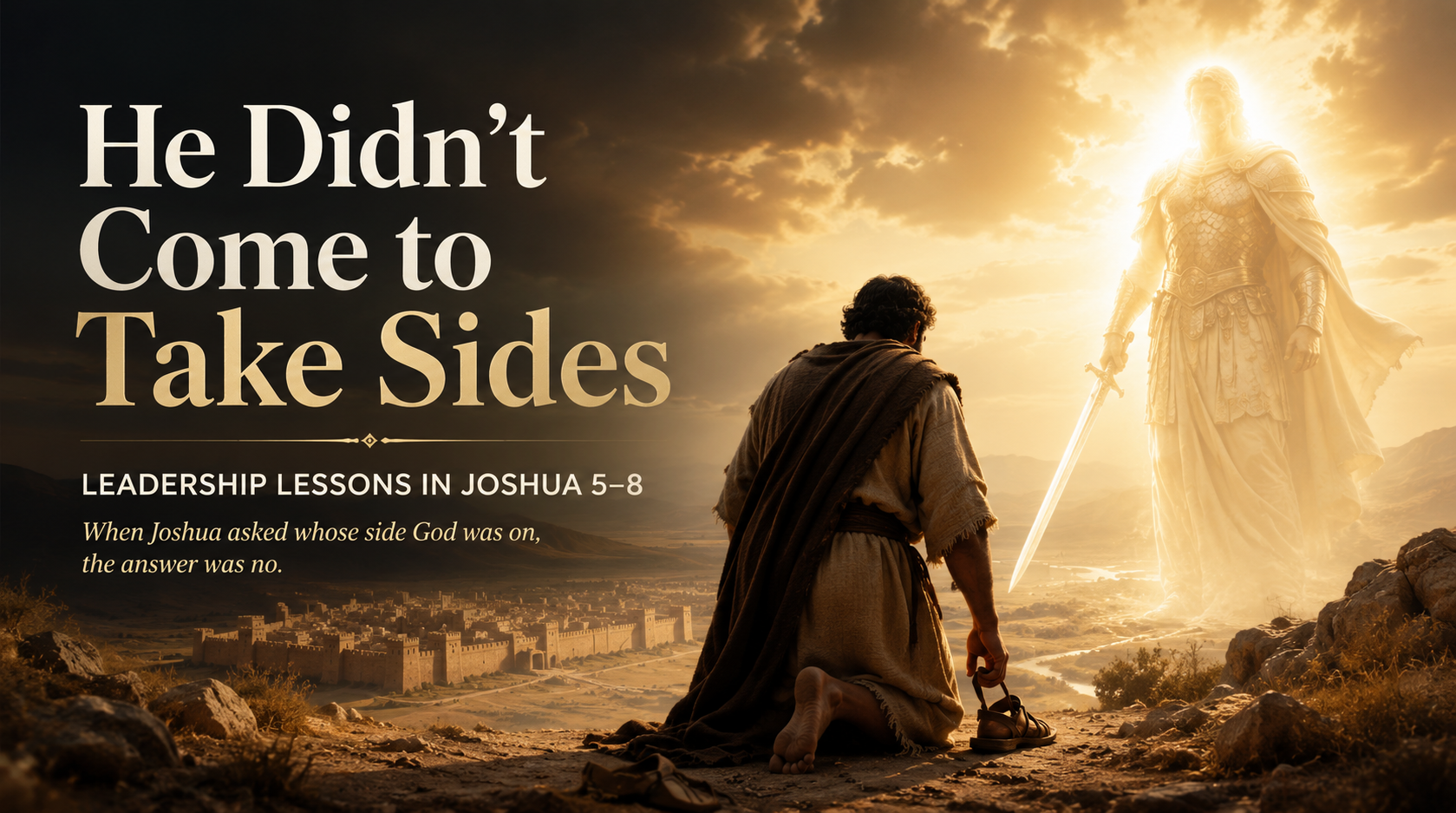
He Didn’t Come to Take Sides: Leadership Lessons in Joshua 5-8
When Joshua asked whose side God was on, the answer was “No.” 5 leadership lessons and a devotional on obedience for business, community, and home.
On the edge of the Promised Land, Joshua sees a man standing with a drawn sword. He is a commander. Joshua is a commander. So Joshua asks the only question a leader knows how to ask:
“Are you for us, or for our enemies?”
And the answer comes back: “No.”
Not us. Not them. The Commander of the LORD’s army had not come to join Joshua’s campaign. He had come to take it over. “Take off your sandals,” He says, “for the place where you are standing is holy.” (Joshua 5:13–15)
That single word, No, reorders everything. We spend our leadership lives quietly assembling God onto our team. We pray for our plans, our launches, our families, our budgets, and we mean it. But the question was never whose side is God on? The question is are we on His?
What follows in Joshua 5–8 is a campaign that strips a leader of every false security one at a time pedigree, weapons, wealth, and even clever strategy and leaves him holding the only thing that ever wins in God’s economy: a surrendered, obedient heart. Here is what it teaches anyone who leads a business, a community, or a home.
Lesson One — Prepare the heart before you sharpen the plan
Before Israel takes a single city, they stop and consecrate. The new generation is circumcised; they keep the Passover. No battle, no movement, just identity dealt with first. (Joshua 5)
Most of us prepare for the fight by sharpening our weapons. We refine the deck, tighten the forecast, rehearse the hard conversation. None of that is wrong. But in God’s economy, preparing for battle has very little to do with sharpening your weapons. It has everything to do with preparing your heart.
In business, this is the discipline of getting your own motives clean before you walk into the room — checking whether you want the win for the mission or for your name on it. In community, it is refusing to lead others where you have not first let God lead you. At home, it is the parent or spouse who deals with their own heart before correcting everyone else’s.
You cannot conquer ground you have not first surrendered.
Lesson Two — Stop asking God to bless your agenda
This is the lesson of the drawn sword. The mature leader stops asking God, will you back my plan? and starts asking God, what are You doing, and how do I get under it?
There is enormous freedom here. If God isn’t a resource you deploy, then the weight of the outcome was never yours to carry. Your job is alignment, not authorship. Sandals off. Command surrendered. He didn’t come to take sides, He came to take command.
The steward-leader’s prayer changes from “Lord, endorse my agenda” to “Lord, enlist me in Yours.” Everything downstream of that prayer gets lighter.
Lesson Three — Be faithful in the “nothing days”
Jericho falls to a liturgy, not a tactic, seven priests, trumpets, and a daily walk around the wall. Six days of circling a city and watching nothing happen. (Joshua 6)
This is the test most leaders fail, because it doesn’t feel like a test. It feels like wasted motion. But He is at work even in the so-called “nothing days” when obedience feels like we’re just walking in circles. Sometimes He is teaching us to trust Him for the outcome instead of trying to achieve it on our own.
The faithful build their best work in the days no one is applauding… the unseen rep, the quiet follow-through, the seventh lap when the wall still hasn’t moved. Obedience is being formed precisely where there is no scoreboard. Keep walking. The wall is on His timeline, not yours.
(A guardrail: this is not a sermon against planning. When Israel returns to Ai in chapter 8, God Himself gives them a battle strategy. The lesson was never anti-planning, it was anti-self-reliance. Plan hard; lean on Him entirely.)
Lesson Four — What you privately keep reveals whom you serve
Then comes Achan. He takes plunder that was devoted to God alone, hides it in his tent, and 36 men die in the next battle for one concealed sin. (Joshua 7)
Notice what kind of failure this is. Achan didn’t steal from his neighbors, he embezzled from God. The plunder was never his to manage for himself; he was a steward who quietly kept what belonged to the Owner. That is why one “small,” private act detonates across the whole community. A hidden heart always has a public cost.
And here is the inversion that should stop every leader cold: just one chapter earlier, Rahab, a Canaanite, an outsider by every measure of blood and morality, is brought inside the covenant by faith. Achan, an Israelite by birth, by his disobedience puts himself outside it. The outsider becomes an insider; the insider becomes an outsider. Belonging to God’s people has nothing to do with race or genes and everything to do with your heart.
For the steward-leader, the application is sharp. The resources you manage, the company’s, the church’s, the family’s, are entrusted, not owned. What you do with them when no one is watching is the truest measure of your heart. Integrity in the hidden ledger is the whole game.
Lesson Five — Re-anchor your identity before you advance
After the victory, Joshua doesn’t press forward to the next conquest. He stops, builds an altar at Ebal and Gerizim, and reads aloud every blessing and every curse of the covenant. (Joshua 8:30–35)
Momentum is dangerous. Success tempts a leader to keep moving and forget why they move. The wise steward periodically halts the advance to re-read the agreement, to remember who they are and Whose they are before taking more ground.
Build the rhythm in. Quarterly, seasonally, at every milestone: stop, return to first things, and let your identity be re-anchored before your calendar fills again.
The Steward-Leader’s Arc
Five movements, internal to external and back to covenant, a model you can return to whenever you face new ground:
- Consecrate — prepare the heart, not the weapon.
- Surrender — get on His side; stop recruiting Him to yours.
- Obey — do the faithful thing even when it looks like nothing.
- Guard — keep the hidden ledger clean; what you privately keep reveals whom you serve.
- Renew — re-anchor your identity before you advance.
A Devotional for Leaders
Read: Joshua 5:13–15
“Neither,” he replied, “but as commander of the army of the LORD I have now come.” Then Joshua fell facedown to the ground in reverence… “Take off your sandals, for the place where you are standing is holy.”
Reflect
You lead something. People look to you to decide the direction, win the ground, carry the weight. And somewhere in that good and God-given responsibility, a quiet substitution can happen: you begin to assume God is on your team, marching under your strategy, blessing the plan you’ve already made.
Joshua’s encounter dismantles that gently and completely. The Commander does not take sides. He takes command. And the first thing required of the great leader Joshua is not a battle plan, it is bare feet and a bowed face. Before he is told to fight, he is reminded to worship.
The ground you stand on today, your business, your team, your home, is holier than it looks. It is not a stage for your strategy. It is an altar for your obedience. The question for this week is not whether God will bless what you’re building. It is whether what you’re building is what He has asked you to build.
Examine (sit honestly with these)
- Where am I asking God to bless a plan I’ve already decided on, instead of asking what He is doing?
- What “nothing day” am I tempted to abandon because I can’t yet see the result?
- Is there anything in my hidden ledger, a resource, a relationship, a habit, that I am quietly keeping for myself that was never mine to keep?
- When did I last stop and re-read the agreement, instead of riding momentum into the next thing?
Pray
Lord, I confess how often I’ve tried to recruit You onto my side instead of getting onto Yours. Today I take off my sandals. This ground is Yours, my work, my people, my home. Prepare my heart before You hand me any victory. Make me faithful in the days that look like nothing. Keep my hidden places clean, and re-anchor my identity in You before I take another step. Not my agenda, but Yours. Amen.
Walk it out this week
Choose one piece of ground you lead; one decision, one relationship, one resource. Before you act on it, take off your sandals: name it aloud as God’s, not yours, and ask Him what He is doing there before you do anything. Then take the next obedient step, even if it looks like walking in a circle.
The wall is on His timeline. Keep walking.

The Shopkeeper Who Asked the Wrong Question
A parable for the everyday believer
A man named Theo kept a shop on the corner of a busy street, and for years it was enough. Then one spring a larger store opened directly across from him. It was brighter, cheaper, and open later, and Theo felt the ground begin to slide beneath him.
So he did what capable men do. He sharpened his weapons. He stayed late redrawing the window displays. He cut his prices until the margins bled. He read every article on how to win, and he made a plan, and the plan was good. Each night before bed he prayed over it: Lord, bless this. Help it work. Be with me against them. He meant every word.
And every morning he rose tired, and the bell over his door rang less than it had the day before.
One evening, long after closing, Theo sat in the dark of the shop with the ledger open and his head in his hands. He did not hear the door. When he looked up, a stranger was standing in the middle of the floor: an old man, plainly dressed, with eyes like still water.
Theo was too weary to be afraid. “We’re closed,” he said. Then, because the man did not move, and because the question had been living in him for months, he asked it aloud: “Are you here to help me, or are you one of them?”
The stranger looked at him for a long moment.
“No,” he said.
Theo blinked. “No… which?”
“Neither,” said the stranger. “I did not come to take your side. I came to ask whether you are on mine.”
The words landed somewhere beneath Theo’s ribs. All this time he had been recruiting heaven onto his team, drafting God into his campaign, asking the King of everything to march under the banner of a corner shop. And here was the question turned inside out, set down in front of him like a mirror.
“Take off your shoes,” the stranger said, and his voice was kind. “This little shop is holier than you have ever guessed. It was never your stage. It was always meant to be your altar.”
Theo, hardly knowing why, slipped off his shoes and stood on the cold floor in his socks, and something in his chest came loose.
“What do I do?” he whispered. “Tell me the strategy.”
“Tomorrow,” said the stranger, “open at your usual hour. Greet whoever comes. Be honest in every small thing. Close on time, and go home to your family, and do not work yourself into the grave trying to save what is not yours to save. Then do the same the next day. And the next.”
Theo frowned. “That’s not a strategy. That’s just… walking in circles.”
“Yes,” said the stranger. “For now.”
“And the walls across the street?”
“Not yours to bring down. Yours only to be faithful while you wait. But first,” and here the old man’s gaze did not soften, though it never grew cruel, “there is a drawer behind the counter. You know the one.”
Theo went cold.
He did know the one. Months ago a customer had overpaid him, a careless mistake, a few crisp bills more than the total required, and Theo had noticed, and said nothing, and slid the difference into the back of a drawer where it had sat ever since. It was a small thing. No one knew. No one would ever know. He had told himself it was practically owed to him, after the year he’d had.
“It is a small thing,” Theo said, but his voice had no conviction in it.
“It is a small thing the way a single thread is a small thing,” said the stranger, “right up until you find it is the one holding the whole garment together. You have been asking why the walls won’t fall. You have been keeping something in your tent that was never yours to keep. A man cannot hold stolen ground in one hand and surrendered ground in the other. Give it back. Then we will talk about walls.”
And then the shop was empty, and the bell over the door had not rung, and Theo stood alone in his socks with the ledger open and his face wet.
In the morning he found the customer’s name in the old records and drove the overpayment back himself, and stammered out an apology, and felt, to his surprise, not smaller for it, but lighter, as though he had set down a stone he’d forgotten he was carrying.
Then he opened the shop at the usual hour.
The first week, nothing changed. The bell barely rang. The big store across the street blazed on. Theo greeted each customer by name, was scrupulous in every small thing, closed on time, and went home to his wife and his children and was present there in a way he had not been in a long while. He prayed differently now. Not bless my plan, but show me what You’re doing, and let me get under it.
The second week, nothing changed.
The third week, an old customer mentioned to a friend that Theo’s was the one shop on the street where a man could still be dealt with honestly. The friend came in. Then the friend’s neighbor. It was nothing you could chart. It was slower than any strategy, and it did not look like winning, and Theo, who had once needed the walls across the street to fall, found one ordinary afternoon that he no longer needed them to. He had stopped fighting for the corner. He had started keeping it for Someone else.
Some say the big store eventually closed, and some say it never did, and the truth is it hardly matters to the story, because the man had already received the only victory that was ever on the table.
He had been asked the wrong question for years: Whose side is God on?
And in the dark of an empty shop, in his socks, with a drawer to empty and a heart to surrender, he had finally been given the right one.
“Take off your sandals, for the place where you are standing is holy.” (Joshua 5:15)
The ground you stand on today is holier than it looks. Empty the drawer. Take off your shoes. And keep walking.
Leave a Reply