
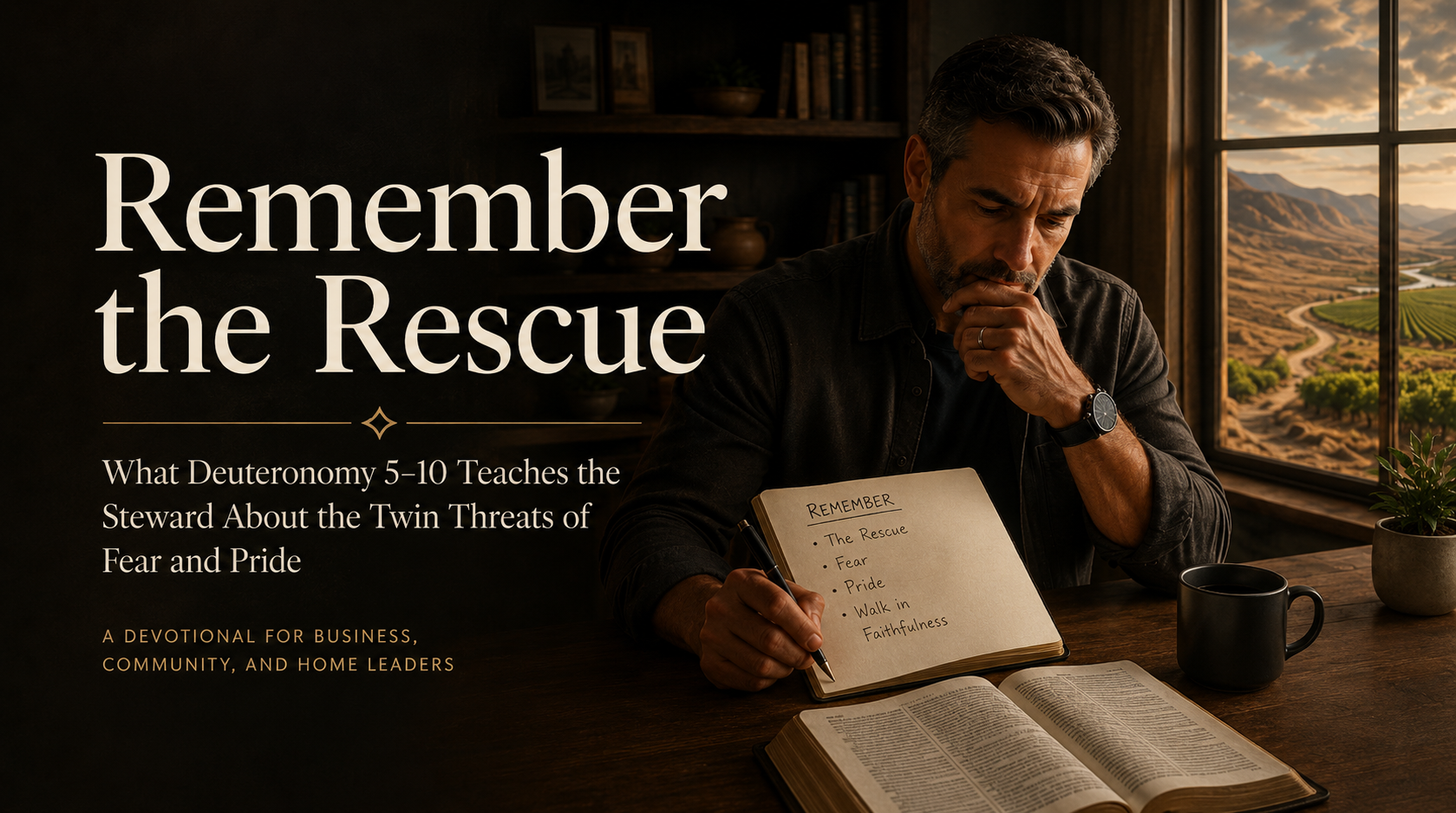
What Deuteronomy 5–10 Teaches the Steward About the Twin Threats of Fear and Pride
A Devotional for Business, Community, and Home Leaders
Opening Reflection
Most leadership failures do not begin where we think they begin. They do not start in the boardroom, the small group meeting, or the kitchen at the end of a long day. They start much earlier, in a quieter place. They start in the moment a steward stops remembering.
Deuteronomy is Moses’ final sermon, delivered to a generation that did not stand at Sinai. Most of these listeners did not see the sea split. They did not eat the first manna. They inherited the rescue. They did not witness it. And Moses spends six chapters circling one urgent concern: what is given without struggle is forgotten without effort.
These six chapters identify the two forces that always corrupt a steward. Fear, which paralyzes the hand and shrinks the God who commissioned it. Pride, which claims credit for what was placed in the hand and erases the One who gave it. Moses treats them as the same disease in two stages. And he prescribes the same medicine for both: deliberate, structured, historically grounded remembrance.
This is the stewardship sermon every modern leader needs to hear, because the people you steward are watching what you remember, and what you forget.
Lesson 1: The Covenant Must Be Personally Claimed
Moses opens his sermon with a line that should arrest every second-generation believer:
“Not with our fathers did the LORD make this covenant, but with us, who are all of us here alive today.” (Deuteronomy 5:3, ESV)
Technically, many of his listeners were not at Sinai. But Moses refuses to let them treat the covenant as ancestral memorabilia. Faith does not pass by inheritance the way property does. It passes by personal claim.
This is the first stewardship test. The business leader who relies on the founder’s vision instead of owning the mission himself will eventually drift. The community leader who quotes his pastor’s convictions without ever wrestling them into his own bones will eventually waver. The home leader who hopes his children will absorb the faith through proximity has misunderstood the architecture of belief.
Joshua will press the same point decades later: “Choose this day whom you will serve.” (Joshua 24:15). No generation gets to coast.
The conviction: The covenant in your house must be yours before it can be passed on. Borrowed faith does not survive the wilderness.
Lesson 2: Remembrance Is Architecture, Not Sentiment
The Shema is not a poetic affirmation. It is a survival protocol.
“Hear, O Israel: The LORD our God, the LORD is one. You shall love the LORD your God with all your heart and with all your soul and with all your might. And these words that I command you today shall be on your heart. You shall teach them diligently to your children, and shall talk of them when you sit in your house, and when you walk by the way, and when you lie down, and when you rise.” (Deuteronomy 6:4–7, ESV)
Seven verbs in three verses. Hear. Love. Internalize. Teach. Talk. Bind. Write. This is not contemplation. This is environmental engineering. The doorposts, the hands, the eyes. Moses is telling the steward to make the truth unavoidable so the lie becomes uncomfortable.
The Hebrew word echad (one) is not merely numerical. It is supremacy and exclusivity. There is one God, and He brooks no rivals on the throne of allegiance.
Modern application is direct. What you steward, you surround yourself with. A leader cannot guard what he does not keep in view. The business leader who never speaks of God in the office has built an environment that catechizes his team into functional atheism. The home leader whose dinner table never mentions the rescue has constructed a house that teaches the children to remember everything except the One who matters most.
The conviction: Remembrance is not a feeling. It is a built environment. Build it, or drift.
Subscribe to get access
Read more of this content when you subscribe today.
Leave a Reply