
Numbers 7-10: The Architecture of Lasting Trust
A study of Numbers 7 to 10 on how leaders build trust that holds, through order, presence, and faithful preparation. Biblical leadership.
There is a question every leader eventually faces, often quietly, sometimes urgently:
How do I get people to truly trust what I am stewarding?
We tend to answer that question with personality, persuasion, or performance. But the Bible offers a different architecture entirely. In Numbers 7–10, God does not simply assign stewards. He builds a system, layer by layer, that embeds trust into the structure before a single step is taken into the wilderness.
These four chapters are not logistical filler. They are a deliberate sequence, a blueprint for how trust is cultivated between leaders, those they serve, and the God who calls them.
And at the center of it all is a principle Jesus would later name explicitly:
“For where your treasure is, there your heart will be also.” — Matthew 6:21
Let’s trace the architecture together.
Lesson 1: Public Investment Creates Shared Ownership
Numbers 7 is the longest chapter in the entire book, and its repetition is not an editorial accident. Over twelve consecutive days, twelve tribal leaders each bring an identical offering for the dedication of the altar. The same gifts. The same structure. Twelve times over.
God did not abbreviate it. He recorded every tribe, every detail, every name.
This deliberate repetition accomplishes three structural things:
- Shared Participation. Every tribe invests materially in the worship system.
- Visible Accountability. The Levites are not self-appointed spiritual elites. The tribes see what is given and why.
- Collective Ownership. The ministry of the Tabernacle becomes a shared responsibility, not a detached priestly enterprise.
The tribes were not merely giving to a building fund. They were specifically resourcing the Levitical function. Wagons and oxen (v. 3–9) were distributed to the Gershonites and Merarites, the Levites responsible for transporting the Tabernacle’s physical structure. They were asked to resource people they did not manage. That requires something more than obedience. It requires trust.
God’s covenantal acknowledgment in this passage is unmistakable: I see you. Your giving is not anonymous. Your investment in what I have set apart matters.
You don’t fund what you don’t believe in. The act of offering was the act of trust.
Investment produces alignment. Jesus identified the same dynamic centuries later. Where treasure goes, the heart follows. Numbers 7 shows the structural groundwork. Matthew 6:21 names the spiritual dynamic. God knew that getting the tribes to give was not a financial strategy. It was a discipleship strategy.
Lesson 2: Consecration Builds Credibility
Before the Levites could receive the trust of the tribes, God had them publicly purified and presented before the entire congregation (v. 9–10). The Israelites laid their hands on them.
That detail matters more than it appears.
This was not a quiet appointment behind closed doors. It was visible consecration, a public moment of identification, transference, and accountability. God was answering the leadership question that never goes away:
Why should we follow them? Why should we give to them? Why should we trust them with what matters most to us?
The public ceremony was God’s answer: I am vouching for these people. Their credibility does not come from their charisma. It comes from consecration.
Notice, too, the sequence. The Levites were presented as a “wave offering” to God (v. 11), meaning they themselves were the gift. Not merely what they could do, but who they were was being offered. Their identity was established before their authority was exercised.
Their loyalty was vertical before it was horizontal. They were given to God first. Then they served the people. That order is not incidental. It is protective. Authority that is not visibly anchored in something higher than self will eventually be questioned.
Trust is not established by competence alone. It is established when a leader’s personhood, their consecration and character, is made visible to those they serve.
For leaders today: before you ask people to invest in your mission, let them see your consecration. Not your credentials. Not your platform. Your character, held accountable to something beyond yourself.
Lesson 3: Obedience Sustains Trust Over Time
Chapter 9 opens not with a new command, but with a reminder: keep the Passover. Before Israel moves an inch, God requires them to remember.
This was not nostalgia. The Passover was a trust-renewal ceremony, a structured act of reconnection to the covenant’s origin. It reminded the people of who God had been, which fueled their confidence in who He would continue to be.
The second Passover provision (v. 6–14) is quietly remarkable. For those who were ceremonially unclean and could not participate on the appointed day, God creates an accommodation rather than an exclusion. A second opportunity. An extended invitation.
The message embedded in that accommodation: no one should be permanently cut off from the opportunity to reconnect. Trust systems that are too rigid breed alienation. God built flexibility into the structure of remembrance.
Then comes the cloud (v. 15–23).
Israel moved when the cloud moved. They stayed when it stayed. Some stops lasted two days. Some lasted a year. They had to learn to trust the timing of God’s leading, not just the direction. That is a far more demanding form of trust. Direction is clear. Timing is ambiguous. Learning to wait on a leader whose pace you cannot control requires a track record of faithfulness.
Trust is not built by a single ceremony. It is sustained by consistent obedience over time, and by leaders who practice the same faithfulness they ask of those they lead.
Stewardship is relational before it is functional. The Levites stewarded the sanctuary. The people stewarded their obedience to God’s leading. Both layers were essential. Neither could substitute for the other.
Lesson 4: Order and Clarity Create Confidence
The silver trumpets in Numbers 10 complete the architecture. God instructs Moses to craft two trumpets with distinct signals for distinct situations: assembly, departure, war, and celebration (v. 1–10). Each signal meant something specific. The people were expected to know the difference.
This is not bureaucratic detail. This is communication design in service of trust.
When people know how decisions are made, when movement will happen, and who leads and who follows, anxiety decreases, suspicion fades, and trust increases.
God does not lead Israel with ambiguity. He builds systems that reinforce predictability and shared understanding. When Israel finally departed Sinai (v. 11–28), they moved in precise tribal order, the same tribes who brought offerings in chapter 7. The sequence was not coincidental. The ones who had given were the ones who marched with dignity and order.
Leadership without clear communication erodes the trust that ceremony, consecration, and remembrance worked to build.
For leaders today: your team does not need you to have all the answers. They need to understand the signals. Clarity of communication is itself an act of stewardship. It honors the trust people have placed in you.
The Theological Thread
What God Was Building All Along
Taken together, Numbers 7–10 reveals a pattern too deliberate to be administrative:
- God invites the tribes to invest materially in Levitical ministry.
- God publicly consecrates the Levites before they exercise authority.
- God reinforces trust through visible, consistent guidance.
- God establishes ordered communication for collective movement.
None of this is accidental. Trust is not assumed. It is embedded into the structure. It is architected before the journey begins.
Jesus crystallized the principle in the Sermon on the Mount: where your treasure is, there your heart will be also. The tribes who gave became the tribes who marched. Their investment was not just financial. It was covenantal. It connected their hearts to the mission, to the Levites, and ultimately to God.
Stewardship in Numbers is not just about managing sacred objects. It is about cultivating relational trust between God, leaders, and the community, and God designed the entire system to make that possible.
Leadership Application
Building the Architecture in Your Context
Whether you lead an organization, a congregation, a team, or a family, the architecture God designed in Numbers 7–10 translates directly into practice. Here are four principles to carry forward:
1. Invite Investment When people contribute, whether time, money, responsibility, or creative energy, they attach emotionally to the mission. Don’t wait until people trust you to invite their participation. Invite their participation as the mechanism through which trust is formed. You don’t fund what you don’t believe in. But you come to believe in what you’ve invested in.
2. Make Your Consecration Visible Character cannot be assumed. It must be demonstrated over time, in public, in accountable structures. This is not about performance or image management. It is about letting those you lead see that your authority is anchored in something beyond your own ambition. Let them see your accountability to God before you ask for their trust.
3. Practice Consistent Obedience to Core Values Predictability builds safety. When your team, congregation, or family can anticipate your behavior based on your stated values, they develop confidence, not in your perfection, but in your direction. Principled consistency with gracious accommodation is the goal.
4. Create Clear Communication Rhythms Ambiguity is the enemy of trust. Establish regular rhythms for updates, decisions, transitions, and celebrations. When people understand the structure, they can rest in it rather than resist it. Order is not control. It is care.
Trust is not a one-time achievement. It is a maintained condition. Numbers 7–10 shows that God did not merely assign stewards. He built an ecosystem designed to protect trust over time.
Devotional
Before You Lead — Be Seen
There is a version of leadership that stays invisible. That keeps its motives hidden, its struggles private, and its accountability minimal. It is efficient, perhaps. But it is not the model God demonstrates in Numbers.
God made the Levites’ consecration public. The tribes laid their hands on them. Every offering was recorded by name. The cloud was visible to the whole camp. The trumpets were heard by everyone.
God’s design for stewardship is not private. It is participatory, visible, and accountable.
This may be the most challenging aspect of faithful stewardship: allowing the people you lead to actually see you, your dependence on God, your areas of growth, your commitment to something beyond your own interests. The Levites did not earn credibility through impressive resumes. They received it through public consecration, through being set apart, visibly and accountably, before the people they would serve.
As you lead today, consider:
- Where have you kept your consecration hidden that God may be inviting you to make visible?
- What would it look like to invite the investment of those you lead, not just financially, but relationally and missionally?
- Is there a trust that needs renewal, not through a single grand gesture, but through consistent, faithful obedience over time?
The architecture of trust is not built overnight. But it is built. One offering, one act of consecration, one faithful day of obedience at a time.
“Well done, good and faithful servant. You have been faithful over a little; I will set you over much.” — Matthew 25:23 (ESV)
A Prayer for the Steward Leader
Father,
We come to You as stewards, not owners. What we have been given, You have entrusted. What we lead, You have called. What we build, You must inhabit, or it will not stand.
Teach us the architecture of trust. Show us where we have led with competence but hidden our consecration. Reveal the places where we have asked for investment before we have demonstrated character. Expose the areas where ambiguity in our communication has eroded the confidence of those who follow us.
May we lead like the Levites who were set apart not by their own choosing, but by Yours. May our authority be anchored in accountability to You, visible enough that those we serve can see where our loyalty lies.
Give us the patience of Israel learning to move with the cloud. Help us to trust Your timing as well as Your direction. And give those we lead the grace to extend trust to us not because we have earned it perfectly, but because they have seen us consecrated to something beyond ourselves.
Where our treasure is, may our hearts faithfully follow. And where our hearts are, may our leadership be faithful.
For Your glory and the flourishing of all You have entrusted to our care.
Amen.

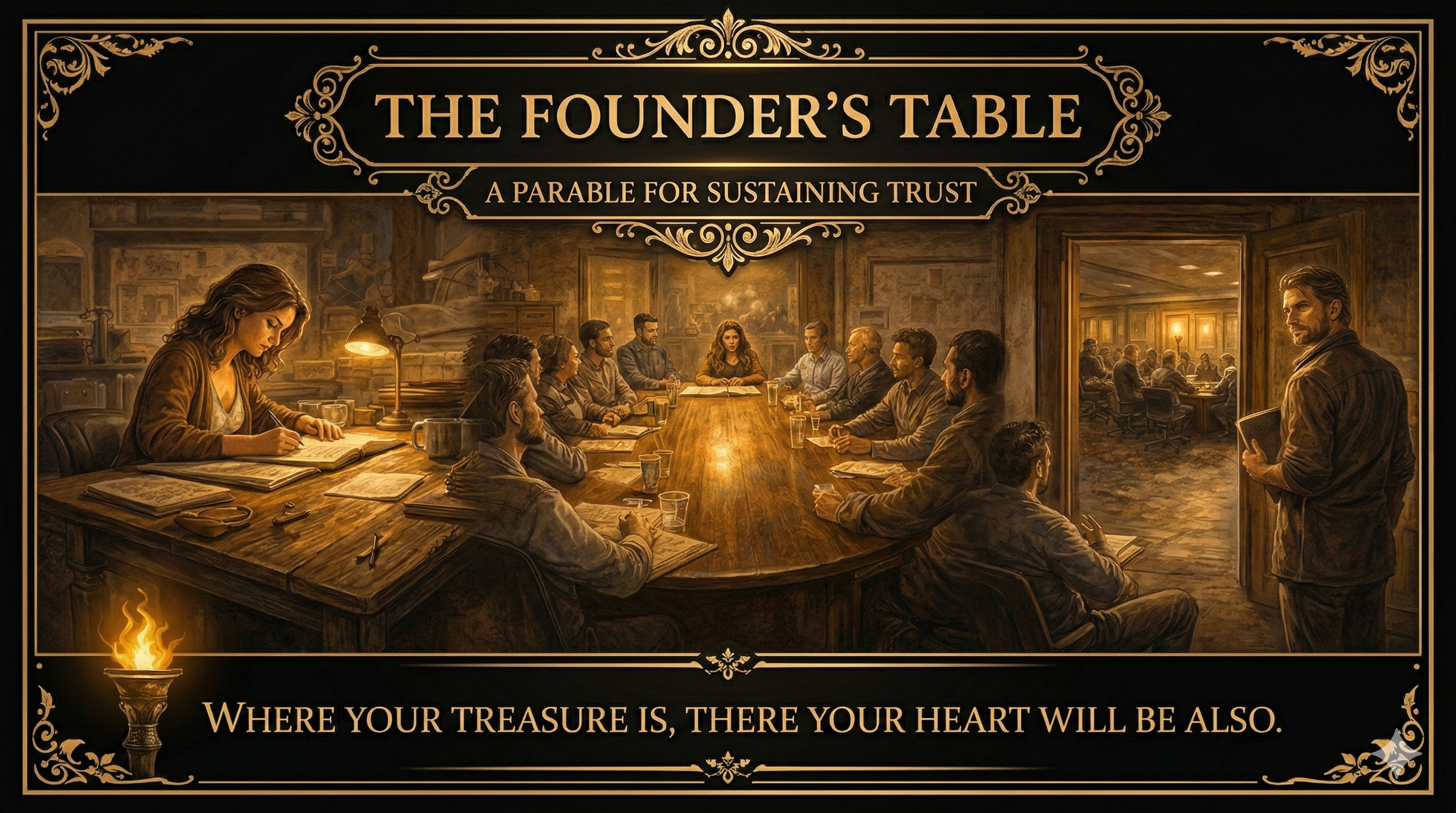
The Founder’s Table
There was once a woman named Miriam who built a company from a single idea and a rented desk in the back of a print shop.
The idea was simple: help small businesses tell their stories better. The company grew slowly at first, then all at once. Within five years, she had forty-three employees, three offices, and a client list that made her competitors uncomfortable.
But somewhere around year four, Miriam noticed something she could not fix with a new hire or a better process. Her people were productive. They were professional. They showed up and they delivered.
They just did not care.
Not the way she cared. Not the way she had cared in the beginning, when caring was the only currency she had. The company had become a place where people traded hours for income, and no one could be blamed for that. It was a fair transaction. It simply was not enough.
So Miriam called a meeting she had never called before. Not a town hall. Not a strategy session. She called it a Founder’s Table, and she invited every team, every department, every level of seniority, to send one person. Twelve people total, seated around the conference table she had bought at an estate sale in year one.
She did not present a slide deck. She did not share the quarterly numbers.
She asked each person at the table to name one thing they had contributed to the company in the past year that they were proud of. Not what their team had done. What they, personally, had put into this place.
Some answers were quick. Some were slow and a little embarrassed. One man named Theodore, a developer who had worked there three years without ever being asked a question like this, was quiet for a long moment before he said that he had stayed late on a Tuesday in February to fix a client’s broken system before their board presentation the next morning. No one had asked him to. No one had known.
Miriam wrote every name and every answer in a notebook she kept at the head of the table.
By the time they finished, something had changed in the room. It was not loud or dramatic. But the people around that table had stopped being representatives of their departments and had become, briefly and genuinely, owners of something together.
Miriam kept the Founder’s Table. She scheduled it every quarter.
But investment alone was not enough. She learned this the hard way when she promoted a man named Garrett to lead the creative division. Garrett was brilliant and she trusted him completely, so she announced the promotion in a company-wide email on a Friday afternoon and moved on.
By Monday, three of the most respected creative leads had requested private meetings with her. The message in each conversation was the same, delivered with varying degrees of diplomacy: we do not know who this person is in this role. We have never seen what he believes. We do not know if he can be trusted with what we have built.
Miriam understood then what she had done. She had appointed without consecrating. She had trusted Garrett in private and expected everyone else to catch up on their own.
She called a different kind of meeting. She asked Garrett to speak, not about his vision or his strategy, but about what he believed the work was for. Why it mattered. Who he was accountable to beyond the quarterly targets. She asked him to stand in front of the people he would lead and let them see not just his competence but his character.
She then asked each of the creative leads to say, publicly, what they needed from him to do their best work.
It was uncomfortable for everyone.
It was also the beginning of something real.
The company grew. The culture strengthened. But there was a season, about two years later, when the market shifted and Miriam had to slow down. She paused hiring. She delayed the product launch everyone had been anticipating. She held the company in a kind of stillness that no one had expected and many found difficult to trust.
Some employees left. The ones who stayed watched Miriam closely.
What they saw was that she communicated every decision and every reason. She did not pretend to have answers she did not have. She did not manufacture urgency to mask her uncertainty. She said plainly: we are waiting because moving now would cost us what we have built. I do not know how long we wait. I know why we are waiting.
She held a Founder’s Table every quarter without canceling a single one, even in the hard seasons, especially in the hard seasons. She kept asking people what they were proud of. She kept writing their names in the notebook.
The stillness lasted fourteen months.
The ones who stayed through it became the most loyal people in the building.
When the company moved again, it moved well. Miriam had by then developed what her leadership coach called a communications architecture, a set of regular rhythms that told the company exactly what was happening, why decisions were being made, who was responsible for what, and how people could raise concerns without going around anyone.
Some of the newer employees found it almost excessive. One young analyst told Miriam candidly that he had never worked somewhere with so many meetings.
Miriam smiled and told him that what looked like meetings were actually signals. And that an organization that did not know the signals could not move together.
He did not fully understand that yet.
He would.
Fifteen years after she had rented that desk in the back of the print shop, Miriam sat at the Founder’s Table with a group that included people who had been with her since year one and people who had joined in the last six months.
She still asked the same question: what have you contributed this past quarter that you are proud of?
A young woman named Priya, three months into her first professional job, said that she had rewritten an onboarding document no one had asked her to rewrite because she thought the original was confusing and new employees deserved better.
Miriam wrote her name in the notebook, which was now its fourth volume.
After the meeting, one of the original twelve, a man named Theodore who was now the head of engineering, stopped in the doorway and said to no one in particular:
*I did not believe in this place when I first walked in. But somewhere between being asked what I was proud of and being seen when I gave my answer, I stopped working for a company and started working for something.*
Miriam heard him. She did not say anything.
She had learned long ago that trust does not announce itself. It simply appears one day, quietly, in the space between what a person gives and what they discover they have become willing to give.
That is how the table always worked.
*Where your treasure is, there your heart will be also.*Add content here that will only be visible to your subscribers.
Leave a Reply