
Exodus 39-40: A Leader’s Final Responsibility
What Exodus 39 to 40 teaches leaders about finishing well, honoring faithful work, and preparing early for what comes next.
Opening Reflection
Leadership is often measured by what gets launched.
We celebrate the vision cast, the initiative started, the momentum built. We study leaders who begin boldly and we try to replicate their energy. But Exodus 39–40 quietly asks a different question — one that gets far less attention and matters just as much.
How do you finish?
These final chapters of Exodus do not introduce a new idea or a dramatic turn. They close a long, detailed narrative of construction and obedience with something rarer and more revealing: work completed with the same faithfulness it was started with, people honored publicly for carrying the load, and a future prepared for before it was needed.
This is not the glamorous side of leadership. It is the stewardship side. And it may be the truest test of whether a leader has actually become one.
Lesson 1 — How You Finish Reveals What You Actually Believe About Excellence
Exodus 39 is repetitive by design. And that repetition is the point.
Again and again, the text returns to a single phrase: “just as the Lord commanded Moses.” The garments — made as commanded. The ephod — made as commanded. The breastpiece, the robe, the turban, the anointing oil — all of it, as commanded. This is not accidental literary style. It is the text insisting that the people carried the same standard of faithfulness to the final detail that they brought to the first.
Nothing was rushed at the end. Nothing was improvised when fatigue set in. No one decided that close enough was good enough because the finish line was in sight.
The conviction: Excellence is not a season — it is a standard. Leaders who bring clarity and discipline to the launch of a vision but allow drift, shortcuts, and diminishing standards as it nears completion are teaching their people something they may not intend: that excellence is situational. That it matters when momentum is high and attention is on you, but fades when the work gets long and the audience gets smaller. Finishing well is an act of integrity — and it tells the people around you more about your actual values than anything you said at the beginning.
Momentum is easy to generate. Faithfulness to the end is rare. That rarity is precisely what makes it powerful.
Lesson 2 — Inspection Is Not Suspicion — It Is Respect
Before any celebration, before any blessing, before a single word of recognition — Moses inspects the work.
He does not take anyone’s word for it. He does not assume that because the people are talented and committed, the details must be right. He looks. He verifies. He confirms that what was built aligns with what was instructed — that the execution matches the standard.
And critically, this inspection is not punitive. There is no atmosphere of suspicion, no undercurrent of distrust. It is simply a leader doing what stewardship requires: taking the work seriously enough to examine it carefully before calling it complete.
The conviction: Inspection and affirmation are not opposites — they are a sequence. Leaders who skip inspection and go straight to celebration communicate, often unintentionally, that the work didn’t really need to be excellent — it just needed to be done. And leaders who inspect without ever affirming communicate that nothing is ever quite good enough. Moses does both, in the right order. He sees the work fully before he speaks about it. In doing so, he honors the people by taking what they built seriously enough to look at it closely.
Inspection is not micromanagement. It is the act of a leader who understands that what gets examined gets taken seriously.
Lesson 3 — Public Recognition Is Not Flattery — It Is Culture Formation
After the inspection, Moses does three things in sequence that every leader should study.
He sees the work. He names its faithfulness. And he blesses the people.
“Moses saw all the work, and behold, they had done it just as the Lord commanded… and Moses blessed them.”
That blessing is brief in the text, but it is enormous in its function. Moses is not simply being generous or warm. He is doing something deeply strategic: he is naming what faithful execution looks like, publicly, in front of everyone — and by naming it, he is defining it as the standard worth repeating.
The conviction: People repeat what is honored. When leaders publicly recognize faithful execution — the attention to detail, the obedience to the vision, the quiet faithfulness of people who carried the work without complaint — they are not just being kind. They are teaching the culture what good looks like. They are calibrating the collective standard. They are communicating that excellence is visible to leadership and that it matters. What goes unrecognized slowly disappears. What is honored becomes the norm.
Recognition is not an add-on to good leadership. It is one of the primary mechanisms by which leaders shape what their culture values and reproduces.
Lesson 4 — God’s Presence Follows Faithful, Completed, Honored Work
The sequence in Exodus 40 is worth reading slowly.
The Tabernacle is assembled. The order is followed exactly. The work is complete, inspected, and affirmed. And then — then — the glory of the Lord fills the Tabernacle. The cloud descends. The presence arrives. The entire massive undertaking of construction, craftsmanship, and obedience culminates in this single, defining moment.
God does not rush into unfinished spaces. He does not fill work that was done halfway, or environments where excellence was treated as optional, or cultures where the vision drifted before it was complete. He fills faithful work — work that was carried all the way to the end with the same devotion it was started with.
The conviction: When leaders build environments of genuine completion — where the standard is held from beginning to end, where work is inspected before it is celebrated, and where faithful people are publicly honored — they create conditions for something greater than what any of them produced. The goal of all of it was never the Tabernacle itself. It was the presence of God among the people. The construction was the means. The presence was the point. And leaders who understand this stop managing for optics and start stewarding for something that cannot be manufactured — an environment where God is genuinely welcome to dwell.
Affirmation doesn’t replace accountability. It completes it. And completion is what makes room for God to move.
Lesson 5 — Succession Is Not a Contingency Plan — It Is a Leadership Responsibility
Underneath the surface of Exodus 39–40 runs a current that is easy to miss if you are only reading for the construction narrative.
God has been extraordinarily specific throughout this entire section about who carries the work forward. The priesthood is not assembled casually. The Levites are chosen deliberately. Roles are defined with precision. Responsibilities are assigned clearly, and the system is designed to function beyond any single individual — including Moses. God does not wait until Moses is gone to decide who leads next. He builds the infrastructure of continuity before the transition is needed.
The conviction: Vision outlives leaders only when succession is intentional. Leaders who are so consumed by the present work that they never invest in preparing the next generation of leaders are not protecting the vision — they are leaving it vulnerable. The work you have built, the culture you have shaped, the values you have embedded — all of it is one departure away from dissolution if you have not been quietly, deliberately developing the people who will carry it next. Succession planning is not a sign that you are ready to leave. It is a sign that you take the mission seriously enough to want it to outlast you.
A bench built too late is not a bench. It is a scramble. And the people you lead deserve better than that.
Lesson 6 — Development Happens Before Authority Is Required
The people who carry God’s work forward in these chapters are not surprised by the responsibility when it arrives.
They have been observing. They have been learning. They have been trusted with increasing responsibility gradually, over time, in ways that prepared them for what came next. Leadership is handed off, not dropped. The transition is the result of intentional formation — not a crisis response to an unexpected vacancy.
The conviction: Strong leaders do not just protect the present — they prepare the future. This means identifying the people around you who carry the values, the character, and the emerging capacity to lead — and then investing in them before it is urgent. It means giving people responsibility before they feel fully ready for it, because readiness is built through experience, not through waiting. It means building a culture where leadership development is not an occasional program but an ongoing practice embedded in how the work is done every day.
In your household, this looks like intentionally developing your children and the next generation — giving them responsibility, teaching them values, and preparing them for leadership long before they hold a title.
In your organization, this looks like identifying your future leaders now — not when a vacancy appears — and building the environment where they grow into their calling.
In your community, this looks like investing in the people coming behind you with the same intentionality someone once invested in you.
The leader who only ever works in the present is building something that will not survive them. The leader who develops people alongside the work is building something that will.
Lesson 7 — Recognition and Succession Are Two Halves of the Same Leadership Commitment
There is a quiet but important connection between Moses blessing the workers and God establishing the priestly succession — and it is this: both are acts of saying you matter and so does your future.
Affirmation tells the people around you that their present work is seen and valued. Development tells them that their future matters and that leadership has invested in it. A culture that has one without the other is incomplete. Recognition without development produces people who feel appreciated but unprepared. Development without recognition produces people who feel useful but invisible. Together, they create something worth staying for — an environment where people are honored for who they are and invested in for who they are becoming.
The conviction: People stay engaged when they feel genuinely seen. Vision endures when leaders are genuinely prepared. Both require intentional, consistent, unglamorous investment from the leader — the kind that rarely makes it into the highlight reel but shapes everything that matters long after the moment passes.
What you honor shapes your culture. Who you develop shapes your legacy.
Personal Reflection
Sit with these questions honestly:
- Am I finishing the work currently entrusted to me with the same faithfulness I started it with — or have my standards drifted as the season has grown long?
- Do I inspect the work of those I lead in a way that communicates it genuinely matters — not as suspicion, but as stewardship?
- Who on my team, in my family, or in my community has done faithful work that I have never publicly honored? What is stopping me?
- Have I identified the people who will carry my vision forward — and am I actively investing in their development now, before it is urgent?
- If I stepped away from my role tomorrow, would the work continue well — or would it struggle because I never built the bench?
Prayer
Father,
Teach me to finish what You have entrusted to me with the same faithfulness I brought to the beginning. When the work grows long and the details feel small, remind me that You are in the details.
Give me eyes to truly see the work of those around me — and the discipline to inspect before I affirm, and the generosity to affirm well and publicly when faithfulness deserves to be honored.
Show me who You are preparing to carry this work forward. Give me the foresight to develop them now, before the need is urgent and the transition is hard.
Let what is built through me endure beyond me — not for my legacy, but for Your purposes.
Amen.
Closing Thought
Moses finishes the work. He inspects it carefully. He blesses the people faithfully. And God ensures the future continues well beyond him.
That is the full arc of stewardship leadership — not just building something, but carrying it faithfully to completion, honoring the people who made it possible, and preparing the next generation to carry it forward before they are needed.
Finish the work well. Honor those who carried it. Prepare those who will carry it next.
That is not just good leadership. That is faithfulness — and faithfulness is what God fills.
Exodus 39–40 | For the leader who is ready to take the final third of their work as seriously as the first.

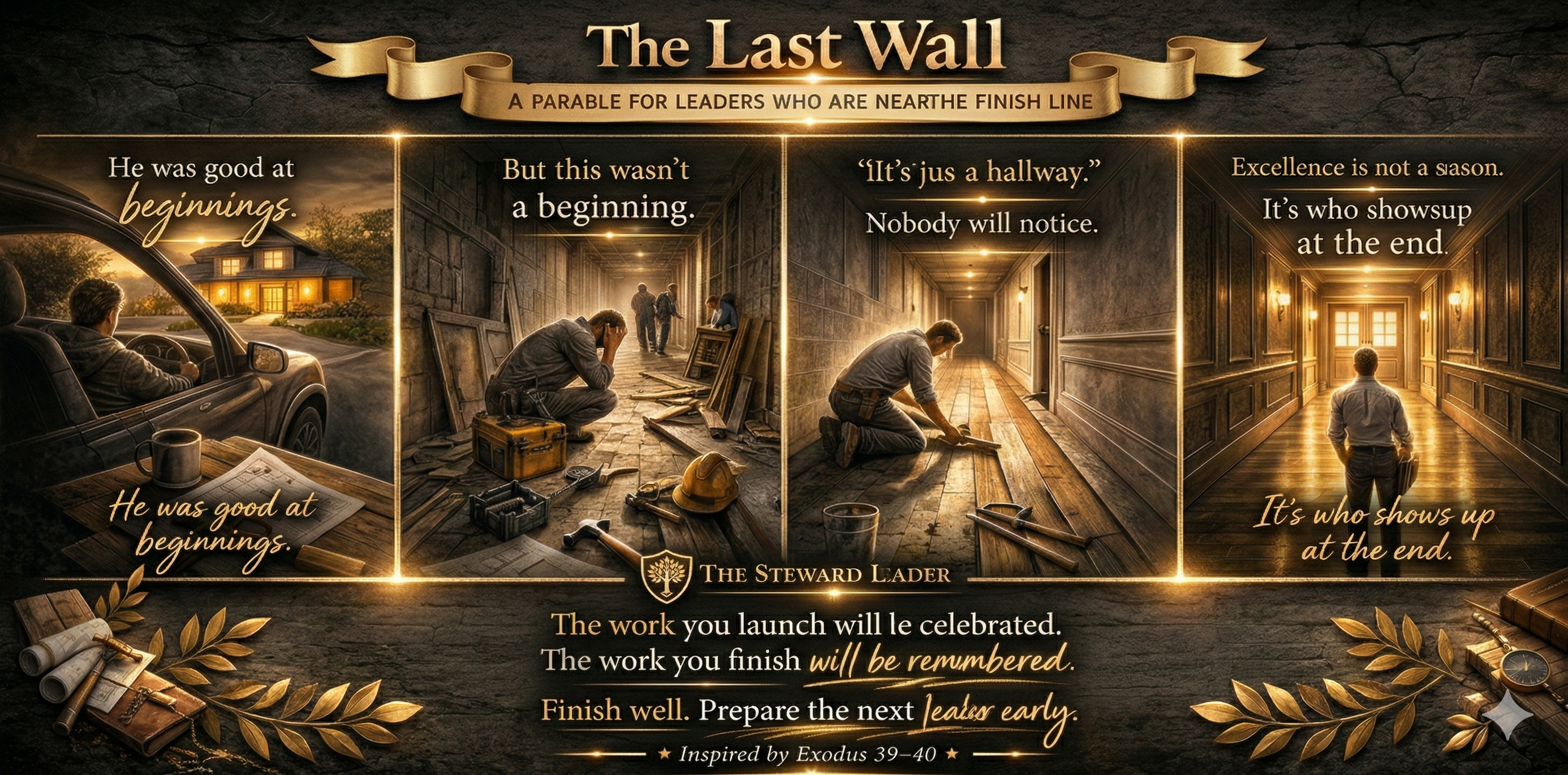
The Last Wall
A Parable for Leaders Who Are Near the Finish Line
Marcus had built things before.
He knew the feeling of breaking ground — the energy of a blank blueprint, the morning everyone shows up early because the vision is still new and the obstacles haven’t arrived yet. He knew how to cast vision. How to gather people around a table and make them believe in something they couldn’t see. He had done it three times in twenty years — a business, a nonprofit, and a marriage that had survived the kind of pressure that breaks most things. He was good at beginnings.
But now he was sitting in the parking lot of the community center at 6:47 in the morning, staring at a building that was almost finished. And almost felt like the most dangerous word in the language.
The renovation had taken eighteen months. A converted warehouse on the east side of the city — a neighborhood that had been told for thirty years that no one was coming. His team had raised the money, hired the contractors, recruited the volunteers. There were nights they worked by flashlight when the electricity failed. There were Saturdays when only three people showed up. There was a Tuesday in November when the roof estimate came back forty thousand dollars over budget and Marcus had sat in his truck in the cold and asked God whether he had heard wrong.
But they had kept going.
And now — now the building was 94% complete. The main hall was done. The kitchen was operational. The classrooms were painted. What remained was the back corridor, a storage room, and a section of flooring that the lead contractor, a quiet man named Darnell, had been working on alone for the past two weeks.
The thing is — no one was going to see that corridor.
It was a back hallway. Utility. The kind of space that exists so that the spaces people actually notice can function. And Marcus had heard the conversation three days ago — had heard two of his younger volunteers laughing about it in the parking lot. “It’s just a hallway. Nobody’s going to know if the trim isn’t perfect. We’re so close. Why are we still sweating the details?”
He hadn’t corrected them. Not yet.
He just kept thinking about it.
Darnell arrived at 7:15, the same time he always arrived. He was sixty-one years old and had been finishing floors for thirty-seven years. He set his bag down, poured coffee from a thermos, and got on his knees in the back hallway without fanfare or announcement, the way he always did — the way Marcus had watched him do it for the better part of a year and a half.
Marcus walked back to find him and stood in the doorway for a moment before speaking.
“You know nobody’s going to see this hallway.”
Darnell didn’t look up. He kept working the edge of a board with slow, deliberate hands. “I’ll see it,” he said. “And you’ll see it. And the kids who run down this hall at 6 AM for the next twenty years will feel it under their feet, even if they never think about it once.”
He set the tool down and looked at Marcus evenly.
“A floor that’s done right is done right all the way to the wall. I don’t know how to do it the other way.”
Marcus stood there for a long moment. Something settled in him that had been restless for weeks — a quiet conviction that had been trying to find words. He thought about every leader he had ever admired and then eventually been disappointed by, and he tried to trace where the disappointment had begun. It was almost always here. Not at the launch. Not at the crisis. But at the end, when the audience had thinned and the energy had faded and the work still required the same person who had shown up at the beginning.
Excellence is not a season.
He had said those words to his team in month three. He wasn’t sure he had lived them in month seventeen.
Two weeks later, on a cold Saturday morning in February, the building was complete.
Marcus gathered the full team in the main hall — volunteers, contractors, staff, a handful of donors who had believed early. Sixty-three people. He had asked each of them to come, but he had not told them why. They arrived in coats and scarves, carrying coffee, talking in small clusters, wondering what this was about.
Marcus walked the building first. Alone. He took forty-five minutes to move through every room, every hallway, every corner. He opened closets. He tested light switches. He ran his hand along the trim in the back corridor. He was not looking for problems. He was bearing witness. He was doing what stewardship required — taking the work seriously enough to see all of it before he said a word about any of it.
When he came back to the main hall, the room went quiet.
He didn’t start with the numbers or the timeline or the total cost. He started with names.
He talked about Renee, who had shown up every Saturday for eleven months even after she lost her job in month four and no one would have blamed her for disappearing. He talked about the three high school students who had painted every classroom over spring break while their friends were at the lake. He talked about Darnell, who had finished a floor that nobody would see with the same hands and the same standard he brought to every floor he had ever laid in thirty-seven years.
And then he said something that no one in the room had expected.
“I want you to hear this clearly. What you built here is not the building. The building is just the building. What you built is proof that faithfulness is possible — that ordinary people can carry a vision all the way to the last wall. And that is worth naming. That is worth remembering. That is worth repeating.”
He paused.
“God does not fill halfway-done things. He fills finished things. And today — this is finished.”
A few people cried. Most of them didn’t expect to.
After the room cleared, Marcus found himself alone with a young woman named Priya — twenty-four years old, sharp, the one who had quietly taken on more responsibility than her title required for the past six months. She had been the first one to arrive on most Saturdays and the last one to lock up. She asked good questions and received hard feedback without going sideways. Marcus had been watching her for months with the quiet, careful attention of someone who already knows what he is seeing.
He asked her to sit down.
“I want to talk to you about the next thing,” he said. “Not because I’m leaving. But because the next chapter of this place is already being formed — and I’d rather form it with you than hand it to you someday without warning.”
Priya looked at him. “You’re talking about development.”
“I’m talking about the fact that everything we built here is one departure away from being lost if I haven’t been building you alongside it.” He leaned forward. “The work deserves better than that. You deserve better than that. And the community that’s going to walk through those doors deserves leaders who were prepared before they were needed, not discovered after it was urgent.”
They talked for two hours.
Outside, the building stood quiet in the February cold. The back hallway was empty and perfectly finished, floor to wall — seen by almost no one, held to the standard of someone who didn’t know how to do it any other way.
And somewhere in the texture of that ordinary faithfulness, in the names spoken publicly and the next leader developed quietly and the work carried all the way to the last wall — something that cannot be manufactured had settled into the building like light.
The presence of a God who fills finished things.
The work you launch will be celebrated. The work you finish will be remembered. The people you honor will become the culture. The leaders you develop will become the legacy.
Finish well. Honor faithfully. Prepare early. That is not just good leadership. That is the work of a steward.
Inspired by Exodus 39–40
Leave a Reply