
Exodus 4-6: When You Feel Unworthy to Lead
What Moses’ excuses in Exodus 4 to 6 teach leaders about feeling unqualified, imposter syndrome, and answering a call you did not choose.
Opening Reflection
At some point, almost every leader hears the same quiet voice.
Who am I to be doing this? What if they find out I’m not as capable as they think? I didn’t earn this. I don’t deserve this. Someone else should be here.
We have given this voice a name — imposter syndrome — and we have built an entire industry around silencing it. Confidence coaching. Leadership development. Mindset work. All of it aimed at the same goal: convincing leaders that the voice is lying and that they are, in fact, enough.
But what if the voice is telling the truth?
What if the feeling of unworthiness is not a psychological problem to be solved, but a spiritual signal to be understood? Exodus 4–6 does not silence Moses’ sense of inadequacy. It reframes it entirely — and in doing so, it offers one of the most liberating leadership truths in all of Scripture.
You are not worthy. And that is exactly the point.
Lesson 1 — God Does Not Argue With Your Inadequacy — He Assumes It
Moses’ resistance to God’s call is one of the most relatable moments in the Bible.
What if they don’t believe me? I am slow of speech and tongue. Please — send someone else. This is not false humility or a negotiating tactic. It is an honest self-assessment from a man who knows exactly what he is and what he is not. And here is what is remarkable: God never disputes it. He does not say, “Moses, you’re more capable than you think.” He does not say, “You just need more confidence.” He does not say, “You’ll grow into it.”
Instead, God asks a question that reframes everything: “Who made man’s mouth? Is it not I, the Lord?”
The conviction: God does not call leaders because they are sufficient. He calls leaders because He is. The reason imposter syndrome is so universal among leaders is that we have been measuring ourselves against a standard God never intended us to meet alone. The gap you feel between who you are and what you have been called to do is not an error in the assignment. It is the design. That gap is where dependence lives — and dependence is exactly where God does His best work.
God is not looking for leaders who are enough. He is looking for leaders who know they are not.
Lesson 2 — Grace Does Not Say “You Are Enough” — It Says “I Am”
The signs God gives Moses in Exodus 4 are fascinating precisely because of what they do not do.
The staff becoming a serpent, the hand turning leprous and then restored, the water becoming blood — none of these build Moses’ confidence in Moses. They do not prove that he is articulate, persuasive, or naturally gifted for the task ahead. What they do is far more important: they strip away every basis for trusting in those things, and redirect trust entirely to the One who is sending him.
Each sign is essentially the same message delivered three different ways: This is not about your capability. This is about My presence.
The conviction: Grace is not the voice that tells you that you are enough. Grace is the voice that tells you He is — and that He is with you. Leaders who have internalized this are genuinely freed from the exhausting performance of trying to appear more capable, more confident, or more qualified than they feel. They are not pretending. They are not white-knuckling their way through. They are leading from a place of acknowledged dependence on a God who has never needed them to be impressive — only obedient.
The goal was never self-sufficiency. The goal was always trust.
Lesson 3 — Your Weakness Is Not a Problem God Overlooked — It Was a Design Consideration
When Moses protests that he cannot speak well, God does not heal his speech. He provides Aaron.
This is worth sitting with. God does not say, “Let me fix your weakness before you go.” He says, effectively, “I will work through it — and around it — and I have already accounted for it in the plan.” Aaron is not a consolation prize or a fallback option. He is a deliberate provision, introduced before Moses ever takes a single step toward Egypt.
The conviction: In God’s economy, weakness is not a disqualifier — it is a design consideration. The gaps in your leadership are not evidence that you were the wrong choice. They are often the very places where God builds the team, provides the support, and demonstrates that the outcomes were never dependent on your individual capacity in the first place. Leaders who understand this stop trying to hide their limitations and start building honestly around them. They attract people who complement rather than merely admire, and they create cultures where no one has to pretend to be sufficient alone.
God never intended leadership to be carried alone. The team is not a sign of weakness — it is a sign that the assignment is real.
Lesson 4 — Obedience Does Not Always Produce Immediate Results — and That Is Not a Sign You Missed God
Moses obeys. And things get worse.
Pharaoh increases the workload. The people turn on Moses with anger rather than gratitude. Morale collapses. And Moses returns to God with the most honest leadership prayer in Scripture: “Why did you send me? Since I came to Pharaoh to speak in your name, he has done evil to this people, and you have not delivered your people at all.”
This is the moment when most leaders conclude they must have misunderstood the assignment. The logic feels airtight: if I were in the right place, doing the right thing, it would be working. But Exodus 5 teaches a harder and more necessary lesson — obedience does not guarantee immediate validation. God is not surprised by backlash. He is not scrambling to adjust the plan. He is shaping something in Moses that results alone could never produce.
The conviction: When imposter syndrome hits hardest — when you have done everything right and the results are still going wrong — it does not mean you were wrong about the calling. It may mean the calling is doing exactly what it was designed to do: forming you into someone who can lead from trust rather than outcomes. The test of genuine leadership is not whether things go well when you obey. It is whether you keep obeying when they don’t.
Resistance after obedience is not evidence you missed God. It is often evidence that you found Him.
Lesson 5 — When You Feel Most Unworthy, God Does Not Elevate Your Confidence — He Anchors Your Identity
Exodus 6 is God’s response to Moses’ crisis of confidence, and it is nothing like what we would expect.
There is no leadership coaching. No pep talk. No reframing of Moses’ strengths. Instead, God reintroduces Himself — slowly, deliberately, and with unmistakable intention.
“I am the Lord. I appeared to Abraham, Isaac, and Jacob. I will deliver. I will redeem. I will take you as My people.”
Notice what is absent: any mention of Moses’ development, growth, or readiness. God does not address Moses’ capability at all. He addresses His own character — His name, His promises, His track record, His faithfulness. Because that is the only foundation that can sustain a leader through what is coming.
The conviction: When you feel most unworthy, the answer is not to find more evidence of your competence. The answer is to remember who sent you. Leadership is sustained by remembrance, not reassurance — by anchoring your identity not in what you have accomplished or what others think of you, but in the character of the God who placed you where you are. That anchor holds when results don’t come, when people turn on you, and when the gap between the calling and your capability feels impossibly wide.
You do not need to feel qualified. You need to remember who qualified you.
Lesson 6 — Imposter Syndrome Is Not a Leadership Flaw — Believing You Are Sufficient Would Be
Here is the word that ties all of it together: grace.
No leader is truly worthy. No one deserves the blessing. No one earns the calling. This is not a crisis — it is the definition of grace. Exodus 4–6 makes clear that God selects leaders based on their hearts, not their skills. He uses hardship as preparation. He walks leaders through wilderness before He places them in positions of influence. And He remains the driving force behind every outcome they will ever produce.
The conviction: Feeling unworthy is not a leadership flaw. It is an accurate self-assessment. The flaw would be feeling sufficient — because sufficiency in leadership is almost always the beginning of the drift toward pride, self-reliance, and the quiet displacement of God from the center of the work. When the feeling of inadequacy rises, the right response is not to silence it or overcome it. The right response is worship — because the feeling is telling you the truth, and the truth is that the God who called you is still far greater than the gap you feel.
When you feel unworthy, praise God — because you are right. And He is still more than enough.
The Leadership Posture Exodus 4–6 Invites
These chapters shape a very specific way of standing in your calling:
Trust God’s assignment over your self-assessment. The internal verdict on your readiness is not the final word. His call is.
Rely on His wisdom over your résumé. What you know and what you have done are not what sustains you. What He knows and what He has promised are.
Trust the preparation He walked you through. Your tribulations were not detours — they were curriculum. The experiences you carry are not incidental. They are provision.
Have faith in His timing, even when results lag behind obedience. The delay is not evidence of failure. It is often evidence of formation.
And when imposter syndrome surfaces — do not silence it. Redirect it. Let it become an act of worship rather than a source of shame.
Personal Reflection
Sit with these questions honestly:
- Am I trying to lead from my own sufficiency — or from honest dependence on God?
- Where have I been hiding my weaknesses instead of building honestly around them?
- Is there a place where God has clearly assigned me, but I’ve been waiting to feel ready before I fully commit?
- When results haven’t followed obedience, have I interpreted that as a closed door — or as a season of formation?
- What would it look like to turn my sense of inadequacy into worship rather than anxiety?
Prayer
Father,
When I feel unqualified, remind me that You are sufficient. When I doubt myself, anchor me — not in my confidence, but in Your character and Your faithfulness.
Teach me to trust where You have placed me, even when I cannot yet see why. Help me to stop measuring myself against a standard You never asked me to meet alone.
Give me the humility to build the team You intended, the patience to trust Your timing when results are slow, and the courage to keep obeying when obedience gets hard.
Let my inadequacy keep me close to You. And let my closeness to You be what sustains everyone around me.
Amen.
Closing Thought
The world will tell you to overcome imposter syndrome. To find your confidence. To stand in your power. To project authority until you feel it.
Exodus offers a different invitation entirely.
Stop trying to close the gap between who you are and what you’ve been called to do. That gap is not the problem. That gap is where God shows up. That gap is where trust is built, where teams are formed, where the work stops being about you and starts being about something far greater.
You are not worthy. No leader is.
Praise God — and lead anyway.
Exodus 4–6 | For the leader who has been waiting to feel ready before they fully step in.

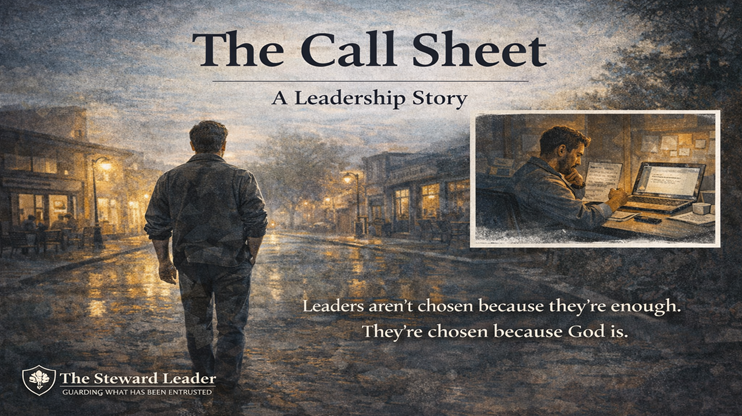
Evan let the email sit unopened for most of the morning. He had seen the subject line the night before and recognized the sender. He knew what it meant, but still, he delayed. Instead, he reread old notes, reviewed numbers he already knew, and straightened things that didn’t need fixing.
When he finally opened it, the message was short: “We’d like you to lead the initiative.” That was it. No praise, no explanation, no reassurance. Just an assignment.
His first reaction wasn’t excitement. Instead, he started taking stock. Who else could handle this better? Who had more experience? Who wouldn’t hesitate like he was right now? He thought about the gaps, the things he still didn’t know, and the moments from his past he’d rather forget. Then, he closed the email.
Later that day, a colleague stopped by. “Congrats,” they said. “You’re ready for this.” Evan gave a polite smile. He didn’t feel ready. Instead, he felt exposed.
That night, he took a walk down memory lane. He wandered through streets he hadn’t thought about in years, jobs that had pushed him to his limits, seasons that had nearly broken him, and decisions that had cost more than they gave. None of it looked impressive, but it was all familiar. Then, it hit him: those moments hadn’t disqualified him; they had shaped him.
The next morning, he replied. “I accept.” Not because the doubts were gone. But because the calling was clear. He stopped asking whether he deserved it. Started asking how to steward it.
The work didn’t get easier. In fact, resistance popped up almost immediately. Pushback. Delays. Quiet skepticism. The doubts crept back in. But this time, he didn’t argue with them. He let them remind him of something truer: This was never about his adequacy. It was about obedience.
Weeks later, someone asked him how he’d found the confidence to take on the role. He paused for a moment and then replied, “I didn’t.” “But confidence wasn’t required.”
Quiet Leadership Truth
Feeling unworthy is not a flaw in leadership.
It is an invitation to trust grace.
Leaders are not chosen because they are enough.
They are chosen because God is.
When doubt surfaces, don’t silence it.
Let it point you back to the One who placed you.
Trust where you’ve been placed.
Pray for wisdom.
And steward what’s been entrusted.
Leave a Reply