
Exodus 30-32: When Leadership Requires Hard Calls
What Exodus 30 to 32 and the golden calf teach leaders about making hard decisions to protect the whole. A stewardship devotional.
Opening Reflection
Every leader eventually has to reckon with a truth they wish weren’t true.
Not every problem is a misunderstanding. Not every failure is accidental. And not every person can stay if the whole is going to survive.
That’s a hard sentence. But Exodus 30–32 doesn’t let us avoid it.
These chapters don’t glorify discipline or celebrate removal. They do something more important — they show us the conditions under which accountability becomes not just appropriate, but necessary. And they reveal something equally important: that the leaders most likely to act rightly in those moments are the ones who did the unglamorous work long before the crisis arrived.
Lesson 1 — You Cannot Enforce What You Never Established
Exodus 30 is not dramatic. That’s precisely what makes it powerful.
Before anything goes wrong, God builds a framework — daily rhythms, shared standards, clear boundaries, defined roles. Nothing here is reactive. No one is being corrected or removed. This is simply a leader doing the foundational work: setting expectations before they are tested, embedding practices before pressure arrives, and making sure people know what “right” looks like before something goes wrong.
The conviction: Accountability without clarity feels arbitrary. Discipline without culture feels like punishment. If the people you lead aren’t sure what you actually value — or if your standards shift based on your mood or the circumstances — they cannot be fairly held to them. The work of building culture is not a soft exercise. It is the most strategic thing a leader can do. Everything downstream depends on it.
You cannot discipline people for violating a standard you never clearly defined.
Lesson 2 — Leadership Absence Creates a Vacuum — and Vacuums Get Filled
Exodus 31 introduces a warning that is uncomfortable precisely because it implicates the leader, not the people.
Moses is away longer than expected. And in that extended absence, the people don’t hold steady — they improvise. They don’t reach for what is faithful; they reach for what is familiar. The golden calf doesn’t appear because the people are uniquely wicked. It appears because leadership went silent, and when clarity disappears, people fill the space with whatever feels manageable.
The conviction: Culture does not maintain itself. It requires consistent leadership presence and communication to stay coherent. Many of the “bad apples” we eventually have to address didn’t begin as rebels — they began as people in an environment where no one was paying attention. Before pointing at the people who drifted, the responsible leader asks: How long was I absent? How long did I go without communicating? What void did my silence create?
Dysfunction rarely appears out of nowhere. It grows in unattended environments.
Lesson 3 — Some Behaviors Don’t Just Hurt Individuals — They Destabilize the Whole
The golden calf incident was not a mistake born of confusion.
The people had witnessed the power. They had heard the standard. They had agreed to the covenant. This was not ignorance — it was defiance. And that distinction matters enormously, because when Moses calls out “Whoever is for the Lord, come to me,” he is not seeking perfection. He is asking one simple question: Will you realign? The separation that follows doesn’t happen because people failed. It happens because some refused the offer to come back.
The conviction: Not all failures carry the same weight. Some behaviors are personal setbacks. Others are contagious. When misalignment goes unchallenged, it doesn’t stay contained — it normalizes compromise, erodes trust, and spreads to people who might otherwise have held firm. There comes a point where a leader is no longer choosing between being kind and being firm. They are choosing between protecting an individual and protecting the mission that everyone else signed up for.
Unchecked misalignment doesn’t just affect the person — it redefines what is acceptable for everyone watching.
Lesson 4 — Be Slow to Anger, but Decisive Once the Line Is Clear
Look carefully at the sequence in these chapters. It matters.
God is patient through the delay. Moses intercedes before any action is taken. A public opportunity for realignment is offered. Only after the refusal — only then — does accountability become swift.
This is not emotional leadership. This is not reactive, ego-driven, or punitive. It is principled leadership — measured in patience, clear in standards, and firm in follow-through. The response is decisive not because the leader lost their temper, but because the standard was already established and the offer to realign was already extended and rejected.
The conviction: Strong leaders do not rush to punish. They are patient, they intercede, they give people the chance to choose differently. But they do not confuse patience with paralysis. Being slow to anger does not mean avoiding the hard decision indefinitely. It means making it without rage, without fear, and without ego — from a place of clarity and responsibility rather than emotion.
Patience is not permission for ongoing dysfunction. It is the grace extended before accountability becomes necessary.
Lesson 5 — Sometimes Protecting the Whole Is the Most Loving Thing You Can Do
Exodus 30–32 does not celebrate removal. But it does justify it — under specific conditions.
When the culture has been clearly defined. When expectations have been communicated. When alignment has been offered and refused. When the behavior threatens not just one person but the integrity of the entire group — in that context, removing what is causing harm is not cruelty. It is stewardship.
The conviction: Leadership accountability is not only about individuals. It is about the community entrusted to your care — the team that is trying to do the right thing, the family that is looking to you to hold the line, the organization whose health depends on shared standards being real and not merely aspirational. Sometimes the most loving thing a leader can do for the many is make a hard decision about one. That is not harsh leadership. That is responsible leadership.
You are not just accountable for the people who cause harm. You are accountable for the people who are harmed by your failure to act.
Personal Reflection
Sit with these questions honestly:
- Have I clearly defined the culture I expect those around me to live by?
- Have I communicated expectations — or only assumed them?
- Am I avoiding accountability out of fear, fatigue, or a desire to keep the peace?
- Am I protecting people — or protecting comfort at the cost of integrity?
- Is there a situation I’ve been tolerating that I know, deep down, requires decisive action?
Leadership demands both compassion and courage. Rarely does it let us choose only one.
Prayer
Father,
Give me the patience to build culture well — before the crisis, before the pressure, before I need it. Give me the wisdom to see when my silence has created a vacuum, and the humility to own that.
When the hard moment comes, help me act without anger, without fear, without pride. Make me decisive where clarity has been given and decisive where integrity demands it.
Make me a faithful steward — not just of those who are thriving, but of everything that has been entrusted to my care.
Amen.
Closing Thought
Great leaders are not measured by how long they endure dysfunction.
They are measured by how faithfully they protect what has been entrusted to them — the mission, the people, the culture they were called to steward.
Build culture before you need to defend it. Be patient with people before you correct them. Extend grace before you act.
But when the moment comes — be courageous enough to move.
Exodus 30–32 | For the leader who knows the right decision but has been waiting for permission to make it.

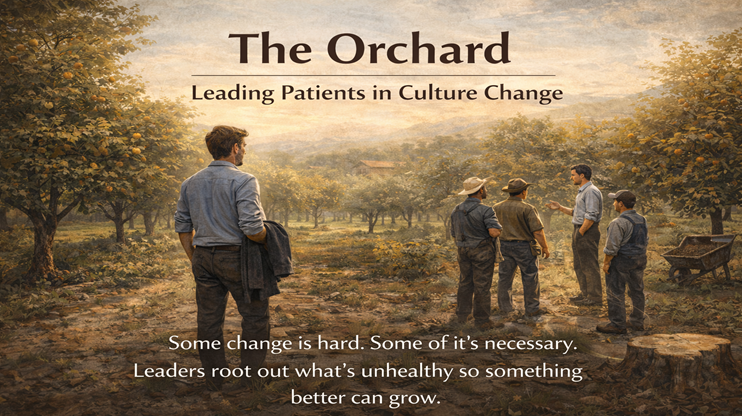
The Orchard
The orchard’s decline wasn’t sudden. That was the detail most overlooked. When Daniel took charge, everything was in place, rows perfectly aligned, irrigation systems functioning, and harvest schedules clear. The established culture was evident. Everyone recognized what healthy growth looked like and knew the expectations.
Initially, the issue was subtle. One tree on the edge yielded less fruit, while another showed signs of rot beneath the bark. Nothing seemed urgent or alarming. “Give it time,” one person suggested. “Every orchard has a few weak trees,” another added. Daniel agreed.
Weeks passed, and the rot spread quietly but persistently. Fruit fell prematurely, attracting insects. The soil nearby began to sour. Workers adjusted without complaint, stepping around the affected area and compensating where they could. Still, Daniel waited. He inspected the rows each morning, careful not to overreact. Removing a tree was irreversible and left a gap that would take years to fill. He believed patience was part of leadership, and he was right.
But patience has limits. One afternoon, a foreman approached him. “If we don’t address this now,” he said, “we’ll lose more than a few trees.” That night, Daniel returned alone. The orchard was quiet, orderly, beautiful, and in one section, undeniably compromised. The issue was no longer a single tree; it was the system around it.
The next morning, he gathered the team. He didn’t raise his voice or point fingers. Instead, he directed their attention to the rows. “This is what healthy growth looks like,” he said, “and this is what threatens it.” He made the expectations clear once more, allowing space for alignment and time for honesty. Some immediately understood, others nodded reluctantly, and one didn’t respond at all.
By the end of the week, the decision was made. The tree was removed, and the sound was louder than anyone expected. Afterward, the orchard looked uneven, exposed, almost wrong. For a moment, Daniel wondered if he had waited too long or not long enough. But over time, things changed. The soil recovered, the insects dispersed, and the surrounding trees strengthened. The gap remained, but the orchard lived.
Later, someone asked him if it was hard to make that call.
He thought for a moment.
“It would’ve been harder,” he said, “to let the whole orchard die while pretending I was being kind.”
Steward Leadership Truth
Effective leaders don’t hastily remove what’s failing. However, exceptional leaders ensure that what’s failing doesn’t impact everything else. Prioritize building a strong culture, be patient with your people, and when the time for accountability arrives, act calmly and promptly.
Leave a Reply