
Exodus 33-35: Rebuilding After Trust Is Broken
What Exodus 33 to 35 teaches leaders about rebuilding a team after trust has been broken, and leading from God’s presence.
Opening Reflection
Every leader eventually faces this moment.
The vision is still valid. The people are still capable. But something has fractured — a broken promise, a public failure, a season of compromise — and now the culture you worked so hard to build feels fragile.
Authority alone won’t restore it. Tighter control won’t either.
Exodus 33–35 quietly reveals what will.
Lesson 1 — Fix the Environment Before You Fix the People
After the disaster of the golden calf, God doesn’t immediately address behavior. He moves the Tent of Meeting outside the camp.
The old environment had become incompatible with the culture He intended to sustain. Before alignment could return, the space itself had to change.
The conviction: Stop expecting people to live out values that your environment actively undermines. Before correcting your team, your family, or your community, examine the conditions you have created. Do people feel safe being honest here? Does your structure reward the behavior you claim to value — or quietly punish it?
The environment is never neutral. It is always either cultivating something or corroding it.
Lesson 2 — Presence on the Front Lines Is Not Optional
Moses doesn’t send messages from a distance. He shows up himself — visibly, consistently, and personally. When he enters the Tent, people watch. Leaders take notice. The community reorients.
Presence communicates what no memo ever can: This matters enough for me to be here.
The conviction: Distance may feel efficient, but it erodes trust faster than almost anything else. Whether you lead a company, a church, a nonprofit, or a household — your people need to see you near the work and near them. Anxiety drops when leaders show up. Alignment becomes possible when leadership is visible.
The fastest way to lose a culture is to lead it from a distance.
Lesson 3 — Consistency in Communication Is an Act of Love
God spoke with Moses “face to face, like a friend” — not once, not only in crises, but consistently. That rhythm of communication is what kept Moses clear, kept the people trusting, and kept the vision unified even after a significant setback.
The conviction: Formal announcements are not the same as real communication. Frequent, informal, honest interaction is what builds the relational tissue that holds a team or family together under pressure. Leaders who only speak up when something goes wrong train their people to associate leadership with anxiety.
Trust is not built in the big moments. It is built in the daily ones.
Lesson 4 — The Strongest Leaders Are the Most Approachable
Moses doesn’t just receive instructions — he pushes back. He asks hard questions. He seeks reassurance. He intercedes. And God responds to it. The intercession matters. The questions change the outcome.
This is not weakness in God’s authority. It is strength in the relationship.
The conviction: The leaders people trust most are not the most rigid — they are the most responsive. When you invite honest feedback without becoming defensive, when you adjust your approach without abandoning your direction, you create an environment where problems surface before they become crises. Authority that cannot be questioned ultimately loses its credibility.
Approachability is not the absence of authority. It is the mark of a leader who is secure enough to listen.
Lesson 5 — Ownership Cannot Be Mandated — It Must Be Cultivated
By Exodus 35, something remarkable happens. The people begin to volunteer. No coercion. No pressure. No fear. They bring their skills, their resources, their energy — freely. Willingly.
This only happens because the preceding work was done: the environment was healed, presence was established, communication was consistent, and feedback was honored.
The conviction: The goal of leadership is not compliance. Compliance is fragile. Ownership is durable. When people feel trusted, seen, and genuinely part of something that matters, they don’t need to be pushed — they step forward. This is true in boardrooms. It is true in congregations. It is true at the dinner table.
Culture enforced is compliance. Culture owned is life.
Personal Reflection
Sit with these questions honestly:
- Does the environment I lead in support the culture I say I want?
- Am I present where my people actually are — or managing from a distance?
- Is my communication consistent, or only situational?
- Do I genuinely invite feedback, or do I merely tolerate it?
- Am I building compliance in the people around me — or ownership?
Prayer
Father,
Teach me to lead with presence, not distance. Help me build environments where trust and clarity have room to grow. Give me the discipline to communicate consistently and the humility to truly listen. Make me secure enough to receive feedback without losing direction. And help me lead in a way that invites ownership — not fear.
Amen.
Closing Thought
Leadership after failure is not about tightening your grip.
It is about rebuilding trust — through presence, through honest communication, through the humility to listen and the courage to show up.
When leaders do that work well, culture doesn’t need to be enforced.
It begins to live again.
Exodus 33–35 | For the leader who is rebuilding after a hard season.

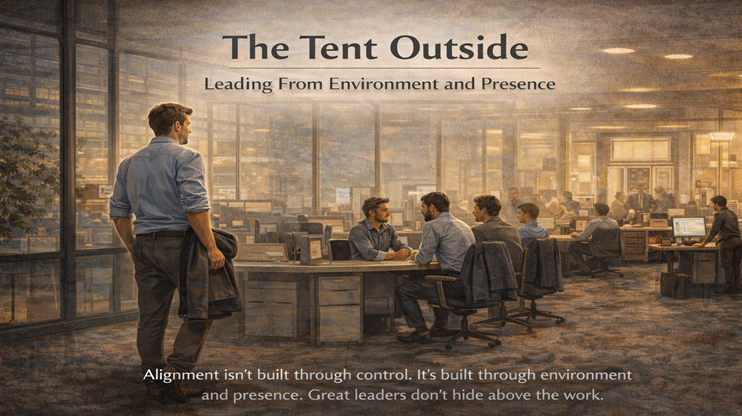
The Tent Outside
The building was still standing. That was the surprising part. Despite everything, the missed signals, the rushed decisions, the trust that cracked under pressure, the company hadn’t collapsed. The lights were on, the teams were working, and the numbers hadn’t fallen apart. But everyone could feel it. Something was off.
Evan was the first to notice the changes in the mornings. Conversations were shorter, meetings felt more cautious, and while everyone did their jobs, no one stuck around. The culture hadn’t vanished, but it had thinned out, like high-altitude air. Instead of calling an all-hands meeting or issuing a memo, Evan made a practical move… he relocated his desk. He left the executive wing and the closed-door floor to sit among the teams. The old setup just wasn’t cutting it anymore.
At first, people watched from a distance. They noticed he arrived earlier than usual, stayed later, and didn’t wait for updates. He asked questions in real time. He listened more than he spoke. He showed up daily, not for announcements but just to be present. Gradually, the atmosphere began to shift.
Every morning, Evan checked in with their leads. No formalities, no scripts. “What are you seeing?” “What’s unclear?” “What’s heavier than it should be?” Some days the answers were small, other days they were more significant. Evan never defended or interrupted. They adjusted when it made sense and explained when it didn’t. The conversations became routine, familiar, and trusted.
One afternoon, a manager unexpectedly objected, “I don’t think this part of the plan will work.” The room fell silent. Evan paused, not out of offense, but to consider the feedback. Then he nodded and said, “Tell me more.” They adjusted their approach accordingly. No announcements were made, no credit was taken, but everyone noticed. Feedback didn’t weaken leadership; it clarified it.
Weeks later, something changed. People started staying longer, not because they had to, but because they wanted to complete things properly. Ideas began to emerge without prompting. Problems were brought up earlier, before they had a chance to escalate. No one was forced to care. They chose to.
As Evan was packing up one evening, someone asked why he had moved his desk instead of just “resetting expectations.” Smiling, he replied, “Expectations aren’t just words on paper. They thrive where leaders are present.”
Steward Leadership Truth
Culture doesn’t recover through control.
It recovers through environment, presence, communication, and listening.
Leaders who want alignment don’t hide above the work.
They step into it… daily.
Leave a Reply